Study of Civilization Through Creativity
Civilization is often measured by its empires, technologies, and political systems. Yet beneath these visible structures lies something less tangible but far more enduring: imagination.
This study begins with a simple premise: art and literature are not decorative elements of history. They are the intellectual framework through which societies think, remember, critique, and evolve.
Here, creative expression is approached not as entertainment but as architectural structures of meaning that shape identity, power, memory, and possibility.
Civilization Begins with Meaning

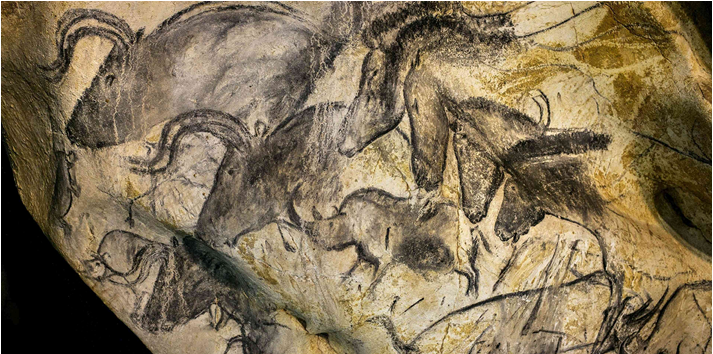
Caption: Early human symbols and stories laid the groundwork for meaning in civilization.
Alt: Prehistoric wall paintings showing symbolic figures representing early human attempts to convey meaning.
Before civilizations built stone monuments, they built monuments of meaning. Long before constitutions, industries, and institutions formalized authority, humans were shaping reality through story, symbol, and image.
Art and literature form the intellectual architecture of civilization. They are systems through which societies understand themselves, preserve collective memory, and project identity into the future.
Every era leaves behind two enduring legacies: what it built and what it expressed. Creative works often survive longer than physical structures.
The Origins of Human Expression

Caption: Early Mesopotamian cuneiform tablets recorded ideas and knowledge for future generations.
Alt: A Mesopotamian cuneiform tablet representing one of the first written systems for preserving thought.
Before written law, formal education, or structured governance, humans used images to externalize experience. Prehistoric cave paintings such as those at Lascaux were not mere decorative gestures; they were cognitive breakthroughs. They represent humanity’s first structured attempts to preserve belief, memory, and narrative beyond immediate experience. With the emergence of writing systems in Mesopotamia and Egypt, literature formalized thought. Religious texts, legal codes, and philosophical reflections allowed ideas to transcend individual lifespans.
From the very beginning, art and literature served one essential function: preserving meaning beyond mortality.
Renaissance Creativity as Intellectual Authority


Caption: Leonardo da Vinci’s Vitruvian Man merges art, science, and philosophy as a hallmark of Renaissance intellectual creativity.
Alt: Vitruvian Man by Leonardo da Vinci, illustrating the integration of art and scientific thought during the Renaissance.
During the Renaissance, creativity became more than expression it became inquiry. Figures such as Leonardo da Vinci demonstrated that art could function as a method of investigation. Anatomy, geometry, proportion, and philosophy converged in artistic practice. In literature, writers such as William Shakespeare expanded narrative into psychological territory, exploring ambition, morality, power, and human vulnerability with unprecedented depth. The Renaissance established a principle still relevant today: creative work can produce knowledge, not merely represent it.
Literature as Social Commentary

Caption: George Orwell’s 1984 demonstrates that literature is a powerful tool for social and political critique.
Alt: Cover of 1984 by George Orwell symbolizing literature’s role in critiquing authority and surveillance.
As societies industrialized and political systems evolved, literature and visual art assumed a critical function. Novels like George Orwell’s 1984 constructed frameworks for interpreting power, surveillance, and ideological control.
Across cultures, artists and writers have interrogated inequality, colonialism, economic structures, and moral conflict. Creative expression often serves as:
- A cultural mirror
- A mechanism of ethical inquiry
- A platform for marginalized voices
- An instrument of reform
Art and literature do not merely reflect civilization; they sometimes redirect it.
Cultural Identity and Collective Memory

Caption: Traditional theatre and cultural arts preserve collective memory and identity across generations.
Alt: Traditional theatre performance showing cultural continuity through artistic expression.
Civilizations articulate identity through creative continuity. Poetry captures emotional climates. Theatre dramatizes political tensions. Folklore encodes belief systems. Architecture signals authority and worldview.
When borders shift or empires decline, artistic and literary works often remain intact, preserving intellectual lineage across generations.
Through creative expression, societies maintain coherence even amid transformation.
Education, Cognition, and Intellectual Development

Caption: Studying literature enhances interpretation, reasoning, empathy, and analytical thinking.
Alt: Students in a classroom analyzing literature, developing critical and cognitive skills.
Educational institutions place art and literature at the core of curricula not out of tradition, but necessity. Literary analysis strengthens interpretation, reasoning, argumentation, and empathy. Visual arts cultivate abstraction, symbolic recognition, and analytical observation. Studying creative expression is structural, not ornamental it cultivates the skills essential for scholarship, citizenship, and leadership.
The Digital Era Expansion Without Dilution

Caption: Digital artists leverage technology to broaden creative reach while preserving meaning.
Alt: Digital artist using a tablet to create art, showing how creativity adapts in the digital era.
Digital transformation has altered distribution but not purpose. Online publishing, digital exhibitions, podcasts, and multimedia storytelling have expanded global access to creative works. Technology accelerates reach, but the fundamental function remains constant: exploring meaning, preserving memory, interrogating power, and shaping identity.
Art and Literature in a Global Dialogue

Caption: International art exhibitions foster cross-cultural understanding and dialogue.
Alt: An international art exhibition showcasing diverse artistic traditions bridging global cultures.
In an interconnected world, creative expression bridges civilizations. Translated novels introduce readers to unfamiliar moral landscapes. International exhibitions connect diverse aesthetic traditions. Performance and narrative reduce cultural distance while expanding ethical awareness.
Where politics often divides, art and literature foster dialogue.
What This Blog Will Explore
This category examines how art and literature shape civilization across time and geography. Future discussions will include:
- Classical and contemporary art movements
- The evolution of literary genres
- Storytelling as a foundation of national identity
- Creativity and political transformation
- The impact of digital innovation on artistic production
Every article will reinforce a central premise: creative expression is foundational to civilization, not peripheral.
The Architecture Endures
Art and literature are not decorative elements of society. They are systems through which civilizations think, remember, critique, and evolve.
From prehistoric markings to digital narratives, human expression continues to define cultural continuity and intellectual progress. To study art and literature is to study the architecture of civilization itself, and as civilization evolves, so too will the forms through which it imagines its future.
0 Comments
- No comments yet. Be the first to share your thoughts.
Join the Conversation
Have thoughts on this article? Share your perspective on Instagram or X (Twitter).